
 February 5, 2014
Each year on the first Wednesday of February Division 1 football commits can sign their National Letter of Intent (NLI) and fax it in to the school of their choice. National Signing Day gives Division 1 bound high school football players the opportunity to make their college decision public and official.
This year, more than 60 football players from New Jersey’s Class of 2014 will fax in their NLI on National Signing Day. Most of those 60+ student athletes made their decision months ago. In past years, some recruits from around the state would postpone their college decision until they could make it official by faxing their NLI.
New Jersey’s top 20 football players have all made their college decisions public and verbally committed to the school of their choice before National Signing Day. With that said, has National Signing Day lost its relevancy?
Senior Paramus Catholic offensive lineman Billy Ray Mitchell committed to Virginia Tech in July. When asked why he ended his recruiting process in the summer going into his senior year, Mitchell said, I felt comfortable where I was at. I really didn’t have any doubts. I really realized that my heart was at Virginia Tech. I love everything about them.”
Mitchell credited his head coach Chris Patridge for helping him handle his recruiting process.
“It’s just constant communication. It seemed like he (coach Partridge) was putting in a lot of effort into it. Like each kid, you know, would sit down weekly. At the beginning, he would talk to you about what schools are your top 10… When he found out what you were interested in, he would attack the schools and keep tabs on you and always remain on constant communication.” Mitchell said.
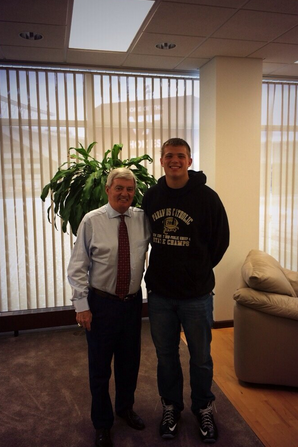
Billy Ray Mitchell pictured with Virginia Tech head coach Frank Beamer during his official visit on Jan. 25
Partridge has coached eight Paramus Catholic players that have earned Division 1 scholarships. The reality of recruiting is that there are players that do not have the guidance they need when it comes to choosing a college. I think not having guidance can contribute to making a college decision much earlier in the recruiting process due to several factors.
Many prospects are hesitant when it comes to realizing what each school really offers them. These student-athletes sometimes struggle to schedule visits, either because they have busy schedules or may not have the money to travel and visit some schools.
Maybe the recruiting process puts pressure on prospects to commit to a school before National Signing Day. When someone is surrounded by other teammates that commit to Division 1 schools, it can become tempting to control your recruiting process. Student-athletes want to participate in the signing day ceremony with their friends.
Media outlets from print to digital cover national Signing Day. That includes newspapers, websites, and television stations. Ceremonies are held at schools for student athletes to sign their papers alongside their parents and coaches. Pictures are taken for the memories. Student-athletes that are going to play Division 1 football want their name in the paper and their picture taken on National Signing Day. More and more tweets show up on a football fan’s Twitter timeline throughout the day with pictures and comments about player’s signings.
The point here is that Signing Day is not what it used to be. The last four-star recruit from New Jersey to commit to a school took place on Jan. 26, when Manalapan wide receiver Saeed Blacknall flipped his commitment from Rutgers to Penn State. Other than Blacknall’s recent flip, every three-star prospect and up has committed to the program of their choice.
Recruits may be making their decisions well ahead of National Singing Day for several reasons besides the lack of guidance. College coaches trying to fill their rosters constantly track recruits. More football recruits could want to get the recruiting process out of the way before their senior season. The closer a player verbally commits to National Signing Day, the better chance they have at flipping their commitment. In Mitchell’s case, he found what he wanted early and stuck to it.
“It’s fun, its a cool thing but I kind of look at it is you’re signing a letter and then its time to get right back to work and get ready for the next level. It’s a cool day, I mean it’s a nice part of your life.” Mitchell said.
Holy Spirit defensive lineman Ray Ellis put his recruiting process on hold until the end of his senior year. The now Florida Atlantic (FAU) commit set guidelines for himself in order to help himself choose a college.
Ellis waited to take visits and speak to coaches until he finished his high school football career.
“Well what helped me most was keeping my recruitment away from my senior season. I just told every coach that I would figure everything out after football was done because you only get one senior year. So setting that in place helped extremely, all of the coaches understood that.” he said.
After an 11-1 record and a Non-Public Group 3 title game appearance, Ellis set up visits to schools he was seriously interested in. He took visits to Delaware and Coastal Carolina prior to his official visit at FAU. Ellis knew FAU was what he wanted when he went down to visit and committed on the spot.
If things didn’t work out as planned in Florida, Ellis said he would have visited Ball State next.
It takes a lot of self-discipline for a high school senior to guide himself through the recruiting process by himself. Ellis deserves a lot of credit for taking command and making those decisions on his own.
Most recruits are unable to make decisions on their own and that’s where I think the early decision-making comes in. In many cases, there is not enough guidance. Rutgers had 12 decommits and now their recruiting class is not nearly as good as it once was. These guys need to ask themselves more probing questions to help them land in the right spot. For example, recruits should not be influenced by where their high school teammates choose to attend college. Let’s not forget that finding a place that can make someone academically successful is just as important as a schools athletic program.
Prospects should ask themselves during a visit, is this where I feel comfortable? If the answer is no, its probably not the right fit. Also, a pros and cons list never hurt. The tips can help eliminate some decommitments (obviously they happen for various reasons), and slow down the recruiting process for most of these guys. This will in turn make National Signing Day more relevant, because more recruits will decide after their senior season.
There is no doubt that a football recruit signing his NLI is memorable, but it doesn’t seem as relevant as it once was due to the majority of early commitments. Is there too much hype to go with National Signing Day?
You decide.


 NJ Football Spot
No comments yet... Be the first to leave a reply!